Showing posts with label women. Show all posts

Friday, November 7, 2014

Friday Art & History Feature - Isabella d'Este

Isabella d'Este, a drawing by Leonardo da Vinci, possibly made for a painting
The Italian Renaissance brought us not only great men - artists and sculptors, like Leonardo da Vinci and Michelangelo, notorious and powerful princes like Cesare Borgia and men who wrote about them, like Michaevelli - but also great women who became a force in their own right.

One such woman was Isabella D'Este, Duke of Ferrara Ercole I D'Este and Eleanor of Naples. Isabella was influential in the political and cultural landscape of the Italian Renaissance, a major patron of arts and an inexhaustible letter-writer, which allows us a glimpse into the society of her time.

Young Isabella d'Este (anonymous painter)
Born in May of 1474 in Ferrara in northern Italy, Isabella was educated in the best classical manner. She was well versed in classical literature and history, could read, write and translate from Greek and Latin and easily held intellectual conversations with the brightest writers and scholars in the court, as well as ambassadors and heads of states. She was the oldest of the Duke's children, and her siblings included Beatrice D'Este, another influential woman of the Renaissance, and brothers Alfonso, Ippolito, Ferrante and Sigismondo. Alfonso would become the third husband of Lucrezia Borgia.

Although she was at first betrothed to, Gianfrancesco, the heir to the Marquis of Mantua, she married his successor ten years later, Francesco Gonzaga. The two deeply admired and respected each other and those feelings eventually grew into real love. Since her husband was often away in Venice as the Captain General of the Venetian armies, Isabella often ruled as his regent.

Isabella's husband, Franceso Gonzaga

She also developed a very close friendship with her sister-in-law, Elisabetta Gonzaga, and the two would go on to be lifelong friends, as their many letters to each other attest to. Four years after her wedding, Isabella gave birth to her first daughter. In total, she and Francesco would have eight children.

When her brother Alfonso married the notorious Lucrezia Borgia, Isabella hosted the festivities but soon turned cold towards her new sister-in-law. She had a reason - jealousy. Lucrezia went on to have a torrid and passionate affair with Isabella's husband, Francesco, which lasted quite a while and only ended at the time of his death from syphillis. During the years of the affair, however, Isabella continued to bear her husband children.

Mantua
Isabella often demonstrated courage and astute mind and competency in political affairs, to the point where some considered her a better and more competent ruler than her husband. When Francesco became a hostage in Venice in 1509, Isabella didn't hesitate to take control of Mantua's military and was able to hold off the invaders until  her husband was released in 1512. She continued to be an important and competent regent during other times her husband was absent, as well as as a regent to her son, Federico. She played a major roles in promoting Mantua to a Duchy and was a wise diplomat in her dealings with our states, and even negotiated with Cesare Borgia.

Besides her political and diplomatic acumen, Isabella was a great patron of the arts and literature, as well as a leader in fashion.  She loved music and played musical instruments herself. Among the great artists she sponsored were Titian, Raphael, Leonardo da Vinci and Bellini. Through her letters we know that she repeatedly asked Leonardo da Vinci to paint her portrait. While there is a knowing drawing of her by Leonardo, the complete painting was not discovered until much later.

Isabella in her 60s, by Titian
A writer Matteo Bandello described her as "supreme among women", while diplomat Niccolo da Correggio called her "The First Lady of the world."

After becoming a widow, Isabella continued to participate in the politics of Mantua and was well loved and respected by her people. In her later years, she turned Mantua into the center of arts and culture, creating a museum and even opening a school for girls. She also collected antiquities.

She died on February 13th, 1539 in Mantua, leaving a great legacy behind her.


Sources: http://en.wikipedia.org/wiki/Isabella_d%27Este
               http://womenshistory.about.com/od/medievalitalianwomen/a/isabella_d_este.htm
               http://italianrenaissanceresources.com/units/unit-8/essays/isabella-deste-collects/


Friday, April 18, 2014

Friday Art & History Feature - The Vikings of History Channel & Lagertha

Vikings poster for Season 2 (History Channel)

I'm a big fan of the History Channel's Vikings, which is currently in its second season, and has already been renewed for the 3rd season.

Vikings does a beautiful job of setting up dark, moody atmosphere in each episode. The morality and the choices of these Vikings are often teetering on the edge of good and evil, only its not seen as good and evil but a fact of life. They live by different rules and they die by different rules. The ruthlessness of vikings is well documented, but this is how they survived, how they conquered and how they lived.


The show also does a formidable job of bringing strong women to the forefront of the story, whether the shield-maiden (warrior) Lagertha, the first wife of the powerful Ragnar Lothbrook (the main character of the show), or princess Aslaug, Ragnar's second wife, whose strength lies in her maternal instincts and character.

Lathgertha by Morris Meredith Williams, 1913
The historical Lagertha comes to us through the 12th century Danish work of history called Saxo Grammaticus. The account in this tale talks of Ragnar meeting this shield-maiden when she fought, along with other abused women, on his side when he came to avenge the death of his grandfather, Siward. She is described as a skillful fighter, her hair loose around her, fighting with the courage of a man. The legend continues with Ragnar courting Lagertha, and her setting two wild beasts on him to protect her home, which he ends up killing, so winning Lagertha's hand in marriage. He had a few children with her but, still not forgiving that she set beasts on him, he eventually divorces her and marries another woman. While this tale is considered a fiction for the most part by scholars, it clearly shows how she was perceived as a noted warrior and courageous personality. There are a few different theories about the real Lagertha, which all lead us to believe that she held considerable power and was possibly a ruler in her own right.


In the Vikings TV show, Lagertha is played (superbly, I might add) by Katheryn Winnick.


Do you enjoy Viking history? Do you watch The Vikings on History Channel? How do you like it?

Friday, December 7, 2012

Friday Art & History Feature - The Women of Renaissance In Portraits

The Women of Renaissance in Portraits

Leonardo Da Vinci  - La belle Ferroniere (Musee du Louvre)   
Possibly a mistress of Franciss I of France.


Leonardo Da Vince Ginevra de' Benci (National Gallery of Art, Washington, D.C.)

Ginevra was a Florentine 15th century aristocratic woman who was admired for her intelligence by her contemporaries.

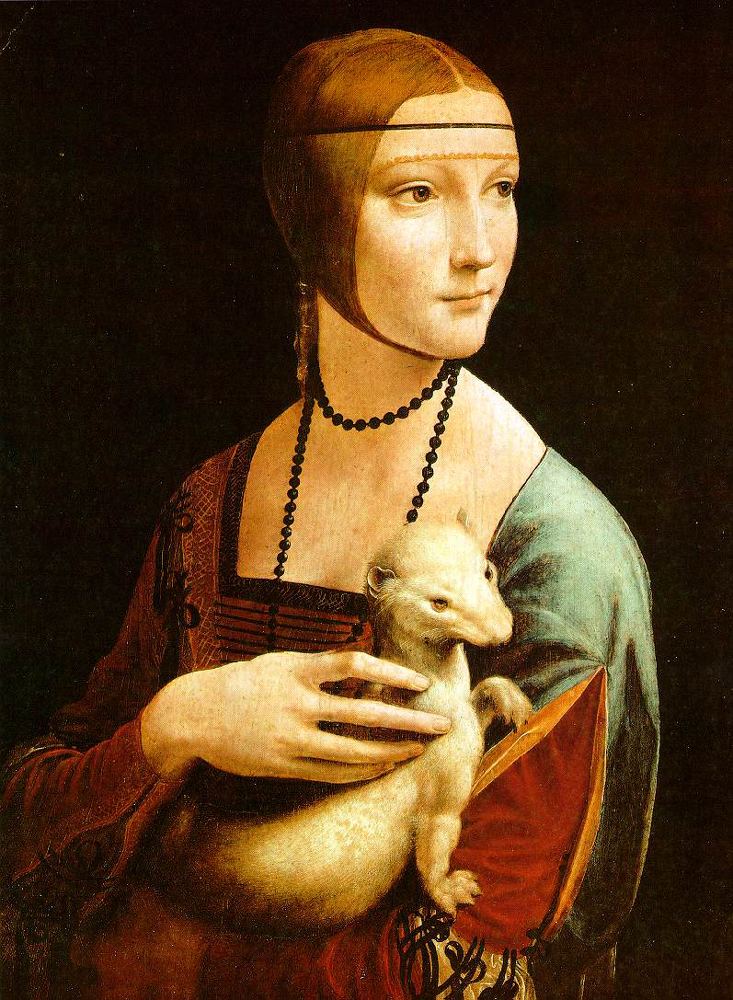
Leonardo da Vinci Lady with an Ermine (1490, Czartoryski Museum, Kraków)
This portrait depics Cecilia Gallerani, the mistress of Leonardo's employer, Ludovico Sforza,
known as "Il Moro".

Rafael, Maddalena Doni (Palazzo Pitti, Florence)


Rafael, La Donna Velata (Palatine Gallery, Palazzo Pitti, Florence)
This portrait is of Rafael's Roman mistress, Margherita Luti.


Hans Holbein, Miniature of Jane Small (c. 1540, Victoria and Albert Museum, London)
An English aristocratic woman.


Hans Holbein, Lady Elizabeth Audley

Young Elizabeth Tudor, artist unkonwn

Portrait of Catherine di Medici, French Queen, artist unkown 
Lorenzo di Credi, Portrait of  Caterina Sforza ( Museum of Forli)

Titian, Isabella d'Este (Kunsthistorisches Museum)
A great woman of the Renaissance, known for her beauty, grace and intelligence. She was a great patron of arts.


Which Renaissance woman would you like to know more about?

Thursday, March 8, 2012

Happy International Women's Day - March 8th

Happy International Women's Day to all of the women in my life and all of the women of the writers community!


I'd like to say a special thank you for everything to my mom, my grandmother, my sister in law, my very dear friend and writing partner Tina Moss and my very dear friend Melissa C., as well as to all of the amazing wonderful women of the writers community who give me so much inspiration, support and motivation!

And I think we should all get a day off today and do all kinds of self-pampering...well, a girl can dream :)

Friday, January 20, 2012

Friday Art & History Feature - Great Women of History

Today, I give you a little preview of some of the feauture Friday History posts I will write during the year. These are the portraits of great women of history that I find fascinating and that I intentend to write about this year for the blog feature.

These women lived in different eras, different countries and within different cultures. Yet they all made an impact on history and on humanity that cannot be denied. Some are well known, while others may not be. They were all strong and fascinating personalities.
This is definitely not a comlete list.
For now, enjoy this picture list.


Cleopatra II


Sofonisba Anguissola - great Renaissance artist
 
Anne Boleyn, 2nd wife of Henry VIII and the mother of the great Queen Elizabeth I


Elizabeth I of the England's Golden Age


Isabella of Portugal


Catherine The Great of Russia


Josephine Bonaparte, the first wife of Napoleon Bonaparte


Marie Curie, the great scientist


Ann Frank


Golda Meir, the 1st female prime-minister of Israel (and the 3rd in the world)
 

Related Posts Plugin for WordPress, Blogger...