Showing posts with label egypt. Show all posts

Friday, June 6, 2014

Friday Art & History Feature - Amelia Edwards

Amelia Edwards 1890 in America (public domain)

This fascinating woman was born the same day as me and is truly inspirational to me.

Amelia Edwards was an English novelist, journalist, world traveler and Egyptologist.


Born on June 7th, 1831, to an Irish mother and a British solider father, she wrote her first poem at the tender age of 7, first story at 12. Over the years, she wrote many poems, stories and five full-length novels, the most famous been Barbara's History (1864).

Philæ from the South (1890) (from A Thousand Miles up the Nile) (Travelers in the Middle East Archive)

Using the proceeds from her writing, Amelia left London to travel. She traveled to Egypt int he winter of 1873 and became fascinated with the land, its culture and history. She spent some time there, and, on her return to England, wrote a beautiful description of her travels on the river Nile. The travel account was later published as A Thousand Miles up the Nile (1877). The travel memoir included Amelia's own drawings.

Great Rock-Cut Temple, Abou Simbel, Nubia (1890) (from A Thousand Miles up the Nile) (Travelers in the Middle East Archive)

 Amelia became a great advocate of research and preservation of ancient cultural monuments. "...Every day, more inscriptions are mutilated–more paintings and sculptures are defaced. ... When science leads the way, is it wonderful that ignorance should follow?" (A Thousand Miles Up the Nile, 1891 edition, pp. 353.) She was the co-founder of the Egypt Exploration Fund (first established in 1882), which survives to this day as the Egypt Exploration Society. The other co-founder was Reginald Stuart Pole. She also toured the United States and gave many lectures on the topic so close to her heart.

Amelia Ann Blanford Edwards by Percival Ball, marble, 1873 (National Portrait Gallery, London)
Amelia died in April of 1892 of influenza and was buried in St. Marie's Church in Bristol. She never married. Her entire collection of Egyptian antiquities was bequeathed to University College London, as well as money to found an Edwards Chair of Egyptology.

Amelia Edward's obelisk tombstone


Resources: http://en.wikipedia.org/wiki/Amelia_Edwards, http://digital.library.upenn.edu/women/edwards/edwards.html




Friday, November 18, 2011

Friday Art & History Feature - The Cult of Isis

NabloPoMo Post #18


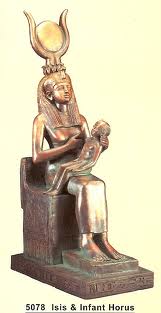
Isis - the mysterious Egyptian goddess with origins in ancient Greece whose influence lasted well into the Roman era and further. Who is she and what has made the cult of Isis so enduring?


 In the Egyptian mythology, Isis, was the daughter of Geb, the god of the Earth and Nut, the goddess of Sky. She was the mother of god Horus, and the sister and wife of Osiris. Her love and devotion for her husband was such that she risked her own life to bring him back to life when he was killed by Set. The legend is that after Set (also a brother to her and Osiris) murdered Osiris, he scattered his body parts so that he couldn't be brought back. However, Isis found all the pieces but one - the phallus, which was swallowed by a fish - and was able to put Osiris back together and made him a new phallus with magic.This is one of the original stories of the magical resurrection. Magic played a large role in the story, as Isis needed to learn magic in order to resurrect her husband. The myth tells of Ra having the necessary magic but refusing to teach it to Isis until she tricks him into revealing his secret name (she makes a snake bite him while she's the only one who can give him the cure for the bite). This is only one version of the Isis legend. She was later also associated with the god Ra and the god Hathor.

It is interesting to note that the concept of learning a deity's name, or "secret name", giving one power over the said deity, goes through many religions, including Judaism.


When Egypt was conquered by Alexander the Great of Greece and later by the Roman Empire, the cult of Isis spread like wildfire through Greco-Roman region.

With the advance of the early Christianity, the worship of Isis did not disappear  completely. In fact, it was incorporated in many places into the Christian worship, as not plausible as that may sound. Many early statues of Mary, mother of Jesus were very similar to the status of Isis.


Isis was known by many names and was the patron goddess of mothers and wives, as well as the goddess of nature and magic. In the Book of the Dead, she is known as “she who gives birth to heaven and earth, knows the orphan, knows the widow, and seeks justice for the poor and shelter for the weak” (Wikipedia: Isis)

What is it that makes Isis so important and endearing to so many peoples and centuries? Her story is the story of spousal and maternal love - themes that are as enduring as time itself. Being the patron of women and nature, she was the one women turned to for protection and understanding of their needs. The role that was later carried on by Mary. Her story appeals to romantics, adventurers and magic legend seekers the world over. It is also appealing to those who enjoy reading about strong women characters who do what needs to be done rather than sit passively by and let things happen to them.


Related Posts Plugin for WordPress, Blogger...