Showing posts with label Leonardo Da Vinci. Show all posts

Friday, November 7, 2014

Friday Art & History Feature - Isabella d'Este

Isabella d'Este, a drawing by Leonardo da Vinci, possibly made for a painting
The Italian Renaissance brought us not only great men - artists and sculptors, like Leonardo da Vinci and Michelangelo, notorious and powerful princes like Cesare Borgia and men who wrote about them, like Michaevelli - but also great women who became a force in their own right.

One such woman was Isabella D'Este, Duke of Ferrara Ercole I D'Este and Eleanor of Naples. Isabella was influential in the political and cultural landscape of the Italian Renaissance, a major patron of arts and an inexhaustible letter-writer, which allows us a glimpse into the society of her time.

Young Isabella d'Este (anonymous painter)
Born in May of 1474 in Ferrara in northern Italy, Isabella was educated in the best classical manner. She was well versed in classical literature and history, could read, write and translate from Greek and Latin and easily held intellectual conversations with the brightest writers and scholars in the court, as well as ambassadors and heads of states. She was the oldest of the Duke's children, and her siblings included Beatrice D'Este, another influential woman of the Renaissance, and brothers Alfonso, Ippolito, Ferrante and Sigismondo. Alfonso would become the third husband of Lucrezia Borgia.

Although she was at first betrothed to, Gianfrancesco, the heir to the Marquis of Mantua, she married his successor ten years later, Francesco Gonzaga. The two deeply admired and respected each other and those feelings eventually grew into real love. Since her husband was often away in Venice as the Captain General of the Venetian armies, Isabella often ruled as his regent.

Isabella's husband, Franceso Gonzaga

She also developed a very close friendship with her sister-in-law, Elisabetta Gonzaga, and the two would go on to be lifelong friends, as their many letters to each other attest to. Four years after her wedding, Isabella gave birth to her first daughter. In total, she and Francesco would have eight children.

When her brother Alfonso married the notorious Lucrezia Borgia, Isabella hosted the festivities but soon turned cold towards her new sister-in-law. She had a reason - jealousy. Lucrezia went on to have a torrid and passionate affair with Isabella's husband, Francesco, which lasted quite a while and only ended at the time of his death from syphillis. During the years of the affair, however, Isabella continued to bear her husband children.

Mantua
Isabella often demonstrated courage and astute mind and competency in political affairs, to the point where some considered her a better and more competent ruler than her husband. When Francesco became a hostage in Venice in 1509, Isabella didn't hesitate to take control of Mantua's military and was able to hold off the invaders until  her husband was released in 1512. She continued to be an important and competent regent during other times her husband was absent, as well as as a regent to her son, Federico. She played a major roles in promoting Mantua to a Duchy and was a wise diplomat in her dealings with our states, and even negotiated with Cesare Borgia.

Besides her political and diplomatic acumen, Isabella was a great patron of the arts and literature, as well as a leader in fashion.  She loved music and played musical instruments herself. Among the great artists she sponsored were Titian, Raphael, Leonardo da Vinci and Bellini. Through her letters we know that she repeatedly asked Leonardo da Vinci to paint her portrait. While there is a knowing drawing of her by Leonardo, the complete painting was not discovered until much later.

Isabella in her 60s, by Titian
A writer Matteo Bandello described her as "supreme among women", while diplomat Niccolo da Correggio called her "The First Lady of the world."

After becoming a widow, Isabella continued to participate in the politics of Mantua and was well loved and respected by her people. In her later years, she turned Mantua into the center of arts and culture, creating a museum and even opening a school for girls. She also collected antiquities.

She died on February 13th, 1539 in Mantua, leaving a great legacy behind her.


Sources: http://en.wikipedia.org/wiki/Isabella_d%27Este
               http://womenshistory.about.com/od/medievalitalianwomen/a/isabella_d_este.htm
               http://italianrenaissanceresources.com/units/unit-8/essays/isabella-deste-collects/


Monday, June 9, 2014

Quote of the Day


I love those who can smile in trouble, who can gather strength from distress, and grow brave by reflection. 'Tis the business of little minds to shrink, but they whose heart is firm, and whose conscience approves their conduct, will pursue their principles unto death.

~ Leonardo da Vinci

Tuesday, May 27, 2014

Quote of the Day


I have been impressed with the urgency of doing. Knowing is not enough; we must apply. Being willing is not enough; we must do.
 
~ Leonardo da Vinci

Friday, December 7, 2012

Friday Art & History Feature - The Women of Renaissance In Portraits

The Women of Renaissance in Portraits

Leonardo Da Vinci  - La belle Ferroniere (Musee du Louvre)   
Possibly a mistress of Franciss I of France.


Leonardo Da Vince Ginevra de' Benci (National Gallery of Art, Washington, D.C.)

Ginevra was a Florentine 15th century aristocratic woman who was admired for her intelligence by her contemporaries.

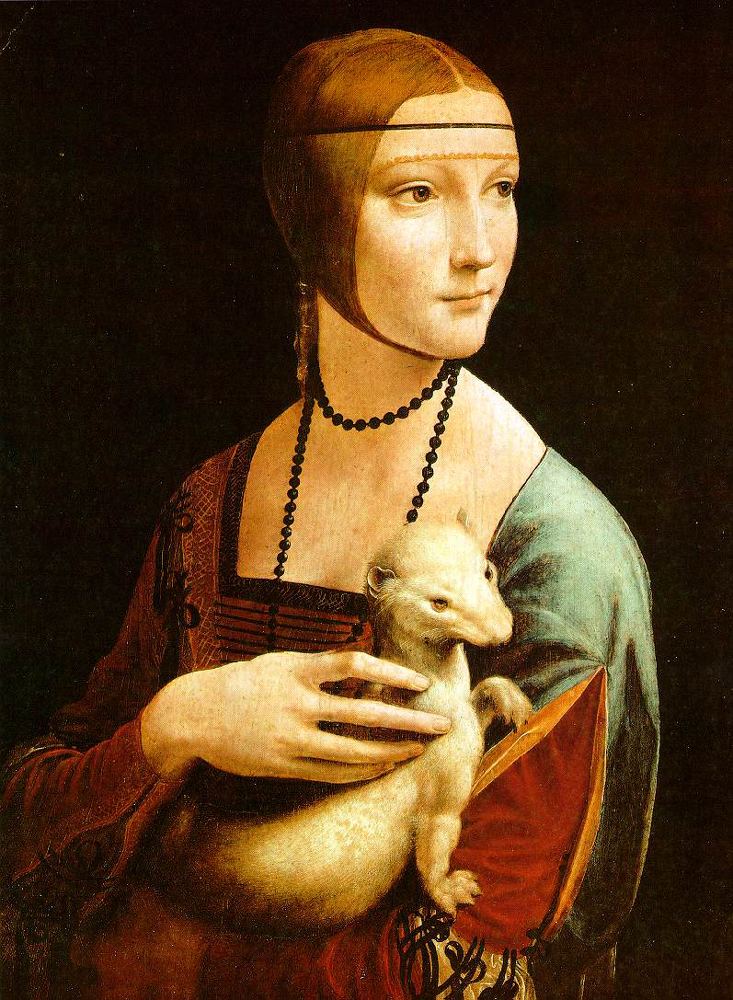
Leonardo da Vinci Lady with an Ermine (1490, Czartoryski Museum, Kraków)
This portrait depics Cecilia Gallerani, the mistress of Leonardo's employer, Ludovico Sforza,
known as "Il Moro".

Rafael, Maddalena Doni (Palazzo Pitti, Florence)


Rafael, La Donna Velata (Palatine Gallery, Palazzo Pitti, Florence)
This portrait is of Rafael's Roman mistress, Margherita Luti.


Hans Holbein, Miniature of Jane Small (c. 1540, Victoria and Albert Museum, London)
An English aristocratic woman.


Hans Holbein, Lady Elizabeth Audley

Young Elizabeth Tudor, artist unkonwn

Portrait of Catherine di Medici, French Queen, artist unkown 
Lorenzo di Credi, Portrait of  Caterina Sforza ( Museum of Forli)

Titian, Isabella d'Este (Kunsthistorisches Museum)
A great woman of the Renaissance, known for her beauty, grace and intelligence. She was a great patron of arts.


Which Renaissance woman would you like to know more about?

Friday, April 20, 2012

Friday Art & History Feature - Hermitage


Today's post mixes art and history. Specifically, it's about one of the greatest art museums in the world - Hermitage. Hermitage, located in St. Petersburg is a State Museum of Russia and its collection rivals that of the Louvre. Hermitage consists of six buildings, although only some of them are open to public. Four of the buildings are called the Winter Palace, Small Hermitage, Old Hermitage and New Hermitage.

Winter Palace
The collection now contained within this museum took its start with Catherine the Great in 1764. She also commissioned the building of an extension to the Winter Palace, which served as the official residence of the Russian monarchs from 1732 all the way up to the Revolution in 1917.

Catherine the Great
By the time Catherine died, her collection contained 4,000 paintings, 10,000 drawings, 38,000 books, 10,000 engraved gems and various coins and medals.

The collection continued to expand in the 19th century through acquisitions by Alexander I and Nicholas I. After the Revolution of 1917, the buildings of the Hermitage and the Winter Palace were merged together as the State museum and collectively called Hermitage.

Small Italian Skylight Room

Room of Modern Sculpture


The museum contains works by Titian, Rafael, Leonardo da Vinci, Velasquez, El Greco, Michaelengelo, Van Gogh, Gauguin, Picasso and hundreds more artists, including many famous Russian painters. It also holds amazing exhibitions of ancient Egyptian, Greek and Roman art, European decorative art, and even Prehistoric art.

Leonardo da Vinci at Hermitage

Raphael at Hermitage


Visiting Hermitage is a must when on a trip to Russia. It will be an unforgettable experience.
Pavillion Hall

Matisse at Hermitage


Friday, November 4, 2011

Friday Art and History Feature - Leonardo da Vinci

NaBloPoMo Post #4

Leonardo Da Vinci
 Two interests have always followed me throughout my life, since I was a little girl - writing (and reading) and art. I remember my mom taking me to all of the museums and exhibitions in Kiev (where I was born and spent my childhood) during the day before school (my school had two shifts, morning and afternoon).
I also remember buying every possible art book that I could find and being fascinated by artist biographies. I painted a little myself as well, mostly watercolors.


One of the artists that influenced me the most is Leonardo Da Vinci, the ultimate Renaissance man. His creativity, ingenuity and an amazing thirst for life have become an inspiration to many generations.
He remains an inspiration to this day. Much of his life, however, remains a mystery.

Mona Lisa
Leonardo's most famous works are Mona Lisa and the Last Supper. Everyone is familiar with them. However, there's a tremendous body of work beyond that.

The Last Supper
 Leonardo was born in 1452 in a Tuscan town of Vinci, to a wealthy notary by the name of Pier da Vinci and a peasant woman by the name of Caterina. At the age of 14, he became an apprentice in the workshop of the artist Verrocchio. During his life, some of the most powerful and influential people of the period served as his patrons. The list includes Lorenzo di Medici, Cesare Borgia and Francis I of France, with whom he became good friends at the end of his life. He died in 1519 in France, under the protection of Francis.


During his life, Leonardo was involved in engineering, medicine, architecture, mathematics and anatomy. His famous notebook, which he wrote using a special code (you can only read it in the mirror), contains detailed drawings of anatomical structures, archetectural designs and engineering inventions. In fact, Leonardo designed a helicopter that, if built today, would be able to fly.

Leonardo's helicopter
 Vasari, the most famous biographer of Renaissance artists, described Leonardo da Vinci as possessing “outstanding physical beauty”, “infinite grace”, “great strength and generosity” and “regal spirit and tremendous breadth of mind”.

Anatomical studies from Leonardo's notebook
As much as is known about this amazing individual, there’s still much mystery surrounding him. For example, it is possible that he was a vegetarian. His spiritual believes are not clear. Even though he lived in Christian societies, it seems that his believes were much more agnostic. Since expressing this would be seen as heretical, it is thought that he hid messages about his believes in his artwork. This was part of the inspiration for the Da Vinci Code by Dan Brown. Another mystery that still remains is Leonardo’s sexuality. Many historians believe that he had a few homosexual relationships throughout his life, especially with his two students Salai and Melzi.

Leonardo Da Vinci, possibly the most versatile genius in history, remains an enigma.
Vitruvian man

Related Posts Plugin for WordPress, Blogger...